Be very amazed
The process that takes a single cell to a functioning organism is one of the most remarkable phenomena in the world.
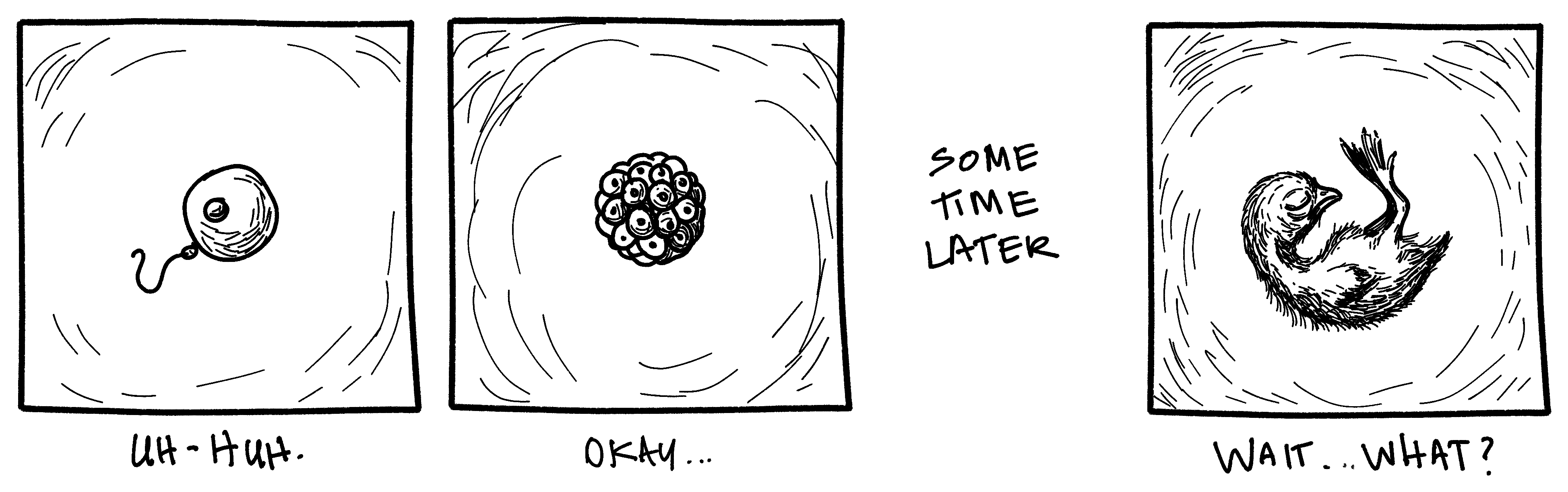
From a single cell and a suitable environment, a functioning organism emerges — with limbs, organs, and attitude. How does such complex order reliably unfold from one tiny cell?
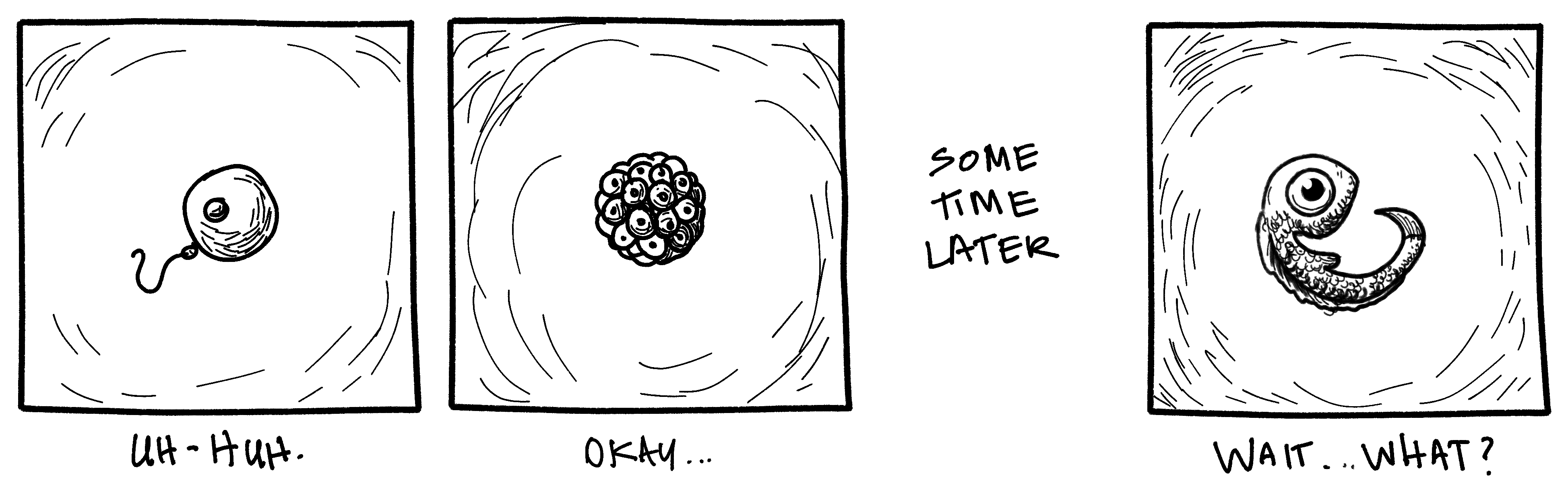
This method of construction is capable of producing a diverse range of forms. Start with a different cell and you get a different, species-typical arrangement — fins, not wings; scales, not feathers. What guides the process to such diverse, specific outcomes?
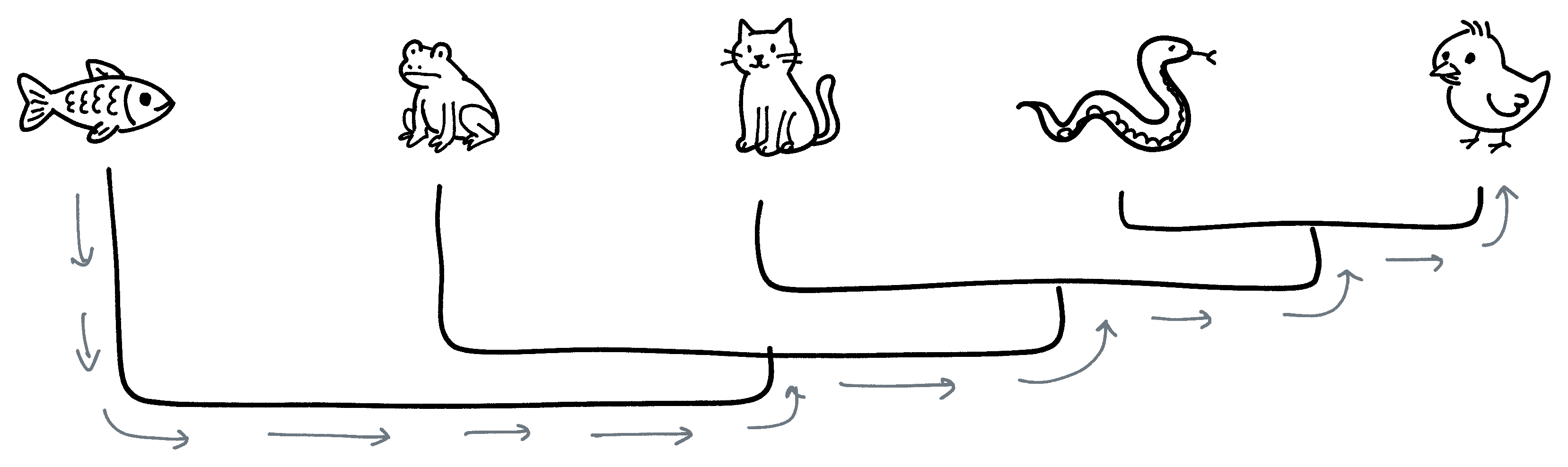
There seems to be some unifying process underlying this diversity. A chick and a fish are very different. Yet they are connected by a continuous series of small, viable changes. How can such a complex process be gradually modified?
Blueprints in the DNA?
How should we explain all this? One common suggestion is that DNA contains a plan, or a blueprint. This gives us a tidy explanation:
- Complex order is explained by the detailed plan written in the DNA.
- Different plans yield diverse outcomes.
- Gradually modifying this plan yields gradual change.
Given the way we build things, it is unsurprising we are drawn to this explanation. But the idea of a plan or blueprint is tied to our top-down process of construction. And, as we noted above, this does not exist.
OK. So here is the cut. There are numerous ways of thinking about XXXX (see xxx) The aim of this website is two-fold.
One approach has been to the problem is to causal parity. That DNA really does play a distinctive role like this. But the real issue is not the idea that xxxx, but that we don’t have a grasp of bottom-up control. Second, that the biological material is difficult to reason about. Need a simpler more accessible world to reason about.
So how should we understand these features? One approach has been to downplay the role of DNA, and to look to alternative sources of order: information from the environment and the spontaneous self-organisation of cells.
Rethink
Probably need to move this stuff to intro.
BUT: We know there is something wrong. There is still plenty of discussion about how best to resolve this. Look at the papers and you’ll see blueprints and xxxx. Dig deeper, and you’ll see deep disatisfaction with these. Overemphasis on genes, and a general engineering metaphors, exemplified in xxxx works.
This website is an attempt to make some headway on this debate. It makes two related bets, theoretical and methodological. First, that a useful way forward is attempt to build something minimal capable of reproducing some of the things that we see in the world of development. The work in evolutoinary computation points the path forward here, but this work in general is focused on optimisation issues, rather than dreving theorotical change or providing insight into biology.
Second, contra many of the altertavise, DNA really does deserve a special causal status in thinking about the set of features above. The problem is not our focus on DNA, but our tethering to top-down ways of exterting control over complex systems. The real issues is that we have need a better understanding of how systematic fine-grained control works bottom-up.
Bottom-up control
Another option lies open, however. What if DNA contains really does have written into it, not a plan or a blueprint, but some sort of control system.
Another option is still open to us. But that does not mean that the idea of control should be abandoned. We can continue to draw on engineering ideas, rethinking and clarifying the role DNA might play in light of construction that proceeds from the bottom up. How would a control system work from the bottom. TODO: A number of ideas from evolutionary computation, but these ideas have been aimed at improving engineering tools. Here, I steer these ideas in the direction of explanation. Trying to construct a simple world etc.
On this website, I present a series of models that explore the idea that DNA is a bottom-up control system. I show how this perspective can shed light on the features above. And rather than ignoring these other, seemingly contradictory ideas, I aim to integrate them, by integrating seemingly contrary ideas, such as environmental plasticity, self-organisation, and goal-directed behaviour. , by integrating seemingly contrary ideas, such as environmental plasticity, self-organisation, and goal-directed behaviour.